KLOW-80 Peptide Blend and the Science Behind Its Skin and Tissue Repair Potential
-
by admin
-
November 10, 2026
-
172 comments
-
6 Minutes read
-
18 views
Four peptides with intriguing connections to collagen, inflammation and tissue repair. But how much of their potential is actually supported by science?
All featured products are selected by our editors and may include affiliate links. If you purchase through these links, we may earn a commission.
Healthy skin depends on much more than collagen. Cellular communication, inflammation, and tissue renewal all influence how skin responds to everyday damage. This explains the growing scientific curiosity surrounding klow-80, a research blend associated with several of these biological processes.
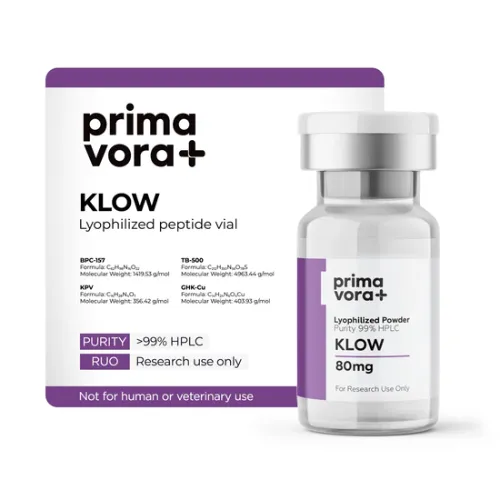
Prima Vora is available for laboratory investigation in an 80mg formulation. But to understand what it might do, we must examine the research behind the proposed ingredients and distinguish promising experiments from demonstrated human benefits.
Why KLOW-80 Is Attracting Attention in Skin and Tissue Research
Skin constantly repairs microscopic damage, replaces aging cells and maintains the structural proteins responsible for firmness and flexibility. As these processes slow down, visible changes can occur, such as loss of elasticity and slower tissue regeneration. Peptide research studies the influence of short amino acid chains on cellular behavior. Some peptides are involved in signaling related to the production of collagen, inflammatory responses, and cell migration involved in repair.
Outside of laboratories, interest has grown. On a Reddit thread about KLOW, people shared their different experiences. Some noted improved skin appearance, but others doubted if combining several peptides offered any real added benefit. These conversations reveal genuine curiosity, although personal experiences cannot establish that a formulation works.
What Makes the Four Peptides In KLOW-80 Interesting
KLOW formulations commonly contain GHK Cu, BPC 157, TB 500, and KPV. Each has a distinct research background, which helps explain why scientists might investigate their biological interactions.
KLOW is, however, a trade name for a blend, not a standardized scientific formulation. The public product description for Prima Vora lists 80mg of material, but does not specify the quantities of the individual components.
GHK Cu and Its Connection to Collagen Research
GHK Cu is a naturally occurring copper-binding peptide that has been studied for its role in skin remodeling and regulation of the extracellular matrix. Laboratory research suggests it may influence collagen production and cellular activities associated with tissue maintenance. Some small human studies involving topical copper peptide preparations have also examined changes in skin appearance.
However, evidence remains limited, and findings involving topical products cannot establish the effects of a combined laboratory peptide formulation.
BPC 157 and Its Role in Experimental Tissue Repair
BPC 157 has attracted scientific interest because animal experiments suggest potential effects on connective tissue recovery, blood vessel signaling, and cellular responses to injury. Some studies have investigated tendon and ligament repair, particularly how tissue responds during different healing stages.
However, human studies are still very limited. Positive results in rodents can not prove efficacy or safety in humans, especially when combined with other experimental compounds.
TB 500 and the Study of Cellular Movement
Cell migration is essential to tissue repair. Cells must move toward damaged areas before rebuilding and remodeling can proceed. TB 500 is associated with research involving thymosin beta 4, a protein involved in actin regulation and cellular movement.
An important distinction is that research on full-length thymosin beta 4 cannot automatically be applied to TB 500, which may refer to a shorter peptide fragment. Their biological properties require separate verification.
KPV and Its Potential Role in Inflammatory Signaling
Inflammation helps initiate tissue repair, but prolonged inflammatory activity can interfere with normal recovery. KPV is a short peptide derived from alpha-melanocyte-stimulating hormone. Laboratory and animal research has examined its interactions with inflammatory pathways, including signaling involving NF kappa B.
These findings provide a reason to investigate KPV further. They do not demonstrate that adding KPV to a four-component blend improves skin conditions or produces measurable clinical benefits.
What Scientists Actually Know About Combining KLOW-80 Peptides
Here lies the most important question surrounding KLOW-80. Individual ingredients may influence different biological pathways, but combining them introduces additional variables. Peptides can differ in stability, molecular behavior, and interactions with surrounding compounds. Even when separate components produce interesting experimental findings, their combined behavior remains uncertain.
A 2026 animal study investigating BPC 157 and TB 500 after Achilles tendon injury found no additional benefit from combining them compared with the individual treatments. More importantly, published research has not established the effectiveness or safety of the complete four-peptide KLOW formulation.
Researchers therefore need evidence addressing several unanswered questions:
- Whether the components remain stable together under specific laboratory conditions.
- Whether their biological activities change when combined.
- Whether observed effects can be attributed to individual compounds.
- Whether the complete formulation produces reproducible experimental outcomes.
This distinction matters because a convincing biological theory is only the beginning of scientific validation.
What Prima Vora Offers With Its KLOW Blend 80mg
Prima Vora lists its KLOW Blend 80 mg as a lyophilized research material intended for controlled laboratory, analytical, and experimental applications. Each vial contains 80mg of the supplied blend. The listed price begins at $97.37 for one vial, with lower per-vial prices available for larger quantities.
The company also advertises domestic U.S. fulfillment, discreet packaging, and shipping within approximately three to five business days after dispatch. For laboratory evaluation, documentation is more important than convenient delivery. Prima Vora states that batch-specific Certificates of Analysis are available for applicable products, with third-party testing where indicated.
Researchers should verify the proper certificate for compound identity, individual quantities, analytical methods and lot matching. The percentage of purity alone does not prove the biological effectiveness or verify the concentration of each and every component. This is especially important when investigating a klow 80 peptide formulation whose exact composition must be established before interpreting experimental results.
FAQs
Can KLOW-80 Improve Skin Appearance?
There is no hard clinical evidence that the full blend is beneficial to human skin. Dermatological research has looked at isolated peptides, but the results from those studies cannot be extrapolated to prove the benefits of this formulation.
Does KLOW-80 Help With Tissue Repair?
Some individual components have shown interesting results in animal injury models. However, controlled human studies have not demonstrated that the complete blend accelerates tissue repair.
What Does the 80mg Strength Mean?
It identifies the total stated quantity of material in a vial. It does not explain the quantity of each peptide. The exact composition requires verification through product specifications and appropriate analytical documentation.
Is KLOW-80 Approved for Human Use?
No. The complete formulation is not FDA-approved for human treatment, and Prima Vora specifically markets its product for laboratory research only.
Scientific interest becomes meaningful when promising explanations survive careful testing. The four peptides commonly associated with KLOW offer intriguing avenues for studying skin biology, yet their combined effects remain largely unexplored.
Clear ingredient identification, reproducible experiments, and rigorous clinical evidence are essential before meaningful conclusions about human benefits can emerge.
Follow HealthInfoLife for more research-informed health content.
POPULAR BLOGS